
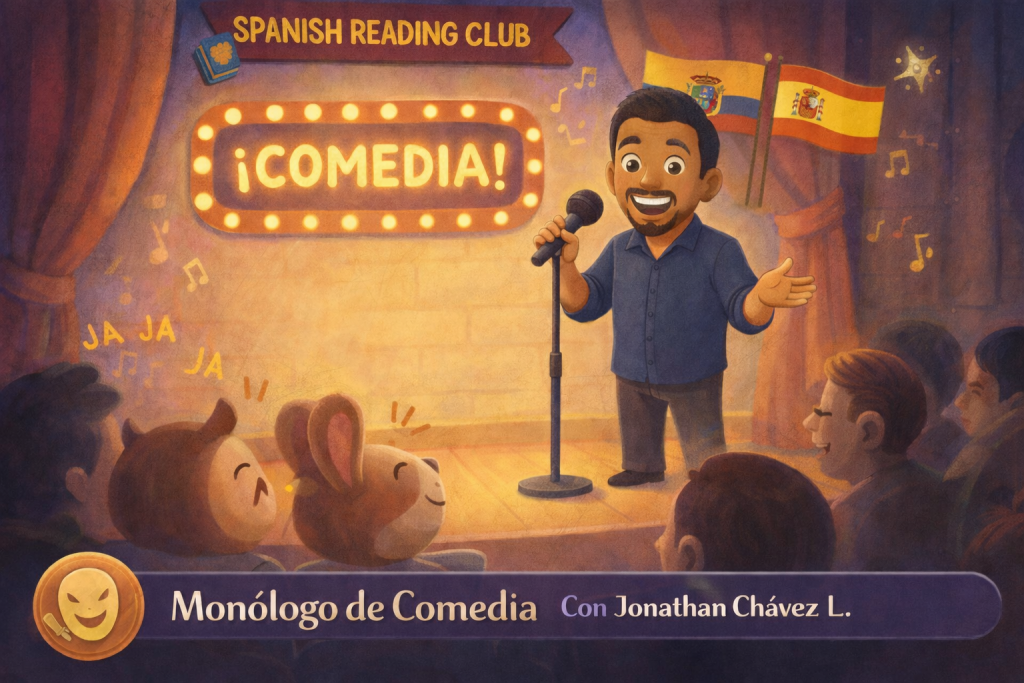
Monólogo de Comedia
Comedy Monologue
In this episode, you will listen to a short stand-up comedy monologue in Spanish presented by Jonathan.
The episode focuses on:
- Career paths and personal choices
- Motivation, habits, and self-improvement
- Humour, irony, and wordplay
While listening, you will practise:
- Understanding spoken Spanish with jokes and rhythm
- Past narration (habits vs. completed actions)
- Learning vocabulary in chunks (fixed phrases), not word-by-word
Before you listen, think about these questions:
- ¿Qué trabajos puedes nombrar en español? Escribe cinco.
- ¿Qué cosas empiezas con motivación pero sueles abandonar? Escribe tres.
Click to Display Word-by-Word Transcript▼
Loading transcript…
Click to Display Spanish Story (Hover for English) ▼
Bienvenidos terrícolas a Spanish Reading Club. Soy Jonathan, y hoy vamos a hacer algo un poco diferente.
En vez de una historia tranquila, les traigo un pequeño monólogo de comedia... en español, para escuchar, reír un poco, y practicar el idioma al mismo tiempo.
Vamos allá.
MONOLOGUE
Hablemos sobre mi experiencia laboral.
No muchos de ustedes saben a qué me dedicaba, antes de ser tutor.
Mi primer trabajo fue de recepcionista en un hotel... y desde el primer día supe que no iba a durar, porque tenía reservaciones.
Siempre he sido así. Incluso de niño quería ser banquero... pero perdí el interés. Literalmente... y financiero.
Entonces pensé: “Ok, voy a trabajar en mí.”
Intenté meditar, buscar paz interior... pero mi mente no cooperaba. Estaba en modo avión, y aun así recibía notificaciones.
Especialmente del gimnasio.
Porque mi relación con el gimnasio es como una prueba gratis: empieza con mucha motivación... y termina sin ningún tipo de explicación.
Así que al final me hice tutor de español.
Porque no requiere fuerza, no requiere interés compuesto... y si alguien se confunde, yo también.
Pero tranquilos... es parte del aprendizaje.
OUTRO
Gracias por acompañarme en Spanish Reading Club.
Espero que este pequeño momento de comedia les haya ayudado a escuchar español de una forma más natural.
Nos vemos en el próximo episodio. Muchas gracias.
If on a phone, scroll right →
| 🧩 Vocabulary — Career & Daily Life (B1–B2) | |||
|---|---|---|---|
| Español | English | Español | English |
| 💼 la profesión | profession | 👩🏫 el tutor / la tutora | tutor |
| 📄 la experiencia laboral | work experience | 🛎️ el / la recepcionista | receptionist |
| 📌 el puesto | position (job role) | 🏨 el hotel | hotel |
| 🏋️ el gimnasio | gym | ❤️ la relación | relationship |
| 🎟️ la prueba gratis | free trial | 🗣️ la explicación | explanation |
| 📈 el interés compuesto | compound interest | 💪 la fuerza | strength |
If on a phone, scroll right →
| 🧠 Vocabulary — Thinking, Mind & Behaviour | |||
|---|---|---|---|
| Español | English | Español | English |
| 🧑💼 dedicarse a algo | to do sth for a living | 📉 perder el interés | to lose interest |
| 🔍 literalmente | literally | ➡️ aun así | even so |
| 🤝 cooperar | to cooperate | 🔔 la notificación | notification |
| ✈️ estar en modo avión | to be on airplane mode | 🧘 buscar paz interior | to look for inner peace |
| ❓ confundirse | to get confused | 📚 el aprendizaje | learning |
If on a phone, scroll right →
| 🧩 Vocabulary — Comedy & Tone | |||
|---|---|---|---|
| Español | English | Español | English |
| 🎤 el monólogo | monologue | 😂 la comedia | comedy |
| 😄 el chiste | joke | 🎯 el remate | punchline |
| 🧠 el juego de palabras | wordplay / pun | 🙃 la ironía | irony |
| 🚀 “Vamos allá” | “Let’s go / here we go” | 🧘 “Pero tranquilos…” | “Don’t worry (plural)…” |
If on a phone, scroll right →
| 🔑 Grammar — Meaning over Words (Jokes, Idioms & Titles) | |
|---|---|
| Español | English |
| En este episodio, se eligieron chistes que funcionan incluso si se traducen literalmente al inglés (o casi). | In this episode, the jokes were chosen because they still work even with a literal translation into English (or almost). |
| Esto facilita la comprensión y permite centrarse en el ritmo y la intención del humor. | This makes listening easier and allows you to focus on the rhythm and intention of the humour. |
| Sin embargo, en la comunicación real, esto no es lo normal. | However, in real communication, this is not the norm. |
| Muchas expresiones, chistes y frases hechas no funcionan palabra por palabra. | Many expressions, jokes, and set phrases don’t work word-for-word. |
| Por eso es mejor aprender un idioma en chunks: grupos de palabras que se usan juntos y tienen un significado propio. | That’s why it’s better to learn a language in chunks: groups of words that are used together and have their own meaning. |
| Un ejemplo clásico es la expresión en inglés “The early bird catches the worm.” | A classic example is the English expression “The early bird catches the worm.” |
| Si se traduce literalmente, en español suena extraña y poco natural. | If translated literally, it sounds strange and unnatural in Spanish. |
| En español, una expresión equivalente es “A quien madruga, Dios le ayuda.” | In Spanish, a common equivalent is “A quien madruga, Dios le ayuda.” |
| Traducción literal: “Dios ayuda a quien se levanta temprano.” | Literal translation: “God helps the person who gets up early.” |
| La idea es similar, pero no hay pájaros, gusanos ni nada que atrapar. | The idea is similar, but there are no birds, worms, or anything to catch. |
| Lo mismo ocurre con los títulos de películas. | The same thing happens with film titles. |
| Un ejemplo es la película 50 First Dates. | One example is the film 50 First Dates. |
| Una traducción literal sería 50 primeras citas. | A literal translation would be 50 primeras citas. |
| En español, el título es Como si fuera la primera vez. | In Spanish, the title is Como si fuera la primera vez. |
| El título español transmite mejor la idea central de la historia. | The Spanish title better conveys the central idea of the story. |
| Otro ejemplo es Eternal Sunshine of the Spotless Mind. | Another example is Eternal Sunshine of the Spotless Mind. |
| Una traducción literal sería Eterno resplandor de una mente impecable. | A literal translation would be Eternal radiance of a spotless mind. |
| En español, el título es ¡Olvídate de mí!. | In Spanish, the title is ¡Olvídate de mí!. |
| Estos ejemplos muestran que el significado es más importante que las palabras individuales. | These examples show that meaning is more important than individual words. |
| Por eso, para entender y usar bien un idioma, conviene aprender frases completas, no traducir todo palabra por palabra. | For this reason, to understand and use a language well, it’s better to learn whole phrases rather than translating everything word by word. |
8. Credits
- Narration: Jonathan Chávez
- Story script: Jonathan Chávez
- Music: “The Carnival of the Animals – Fossiles” by Camille Saint-Saëns, trimmed for use. Licensed under Creative Commons Attribution–ShareAlike 2.0 (CC BY-SA 2.0). Source: Wikimedia Commons.
- Sound effects: sourced from Mixkit
- Video production: Envato VideoGen
- Audio and video editing: Jonathan Chávez
- Transcription: Jonathan Chávez
- Study guide writer: Gabriel Chávez
- Images: ChatGPT