
Please Log In
 

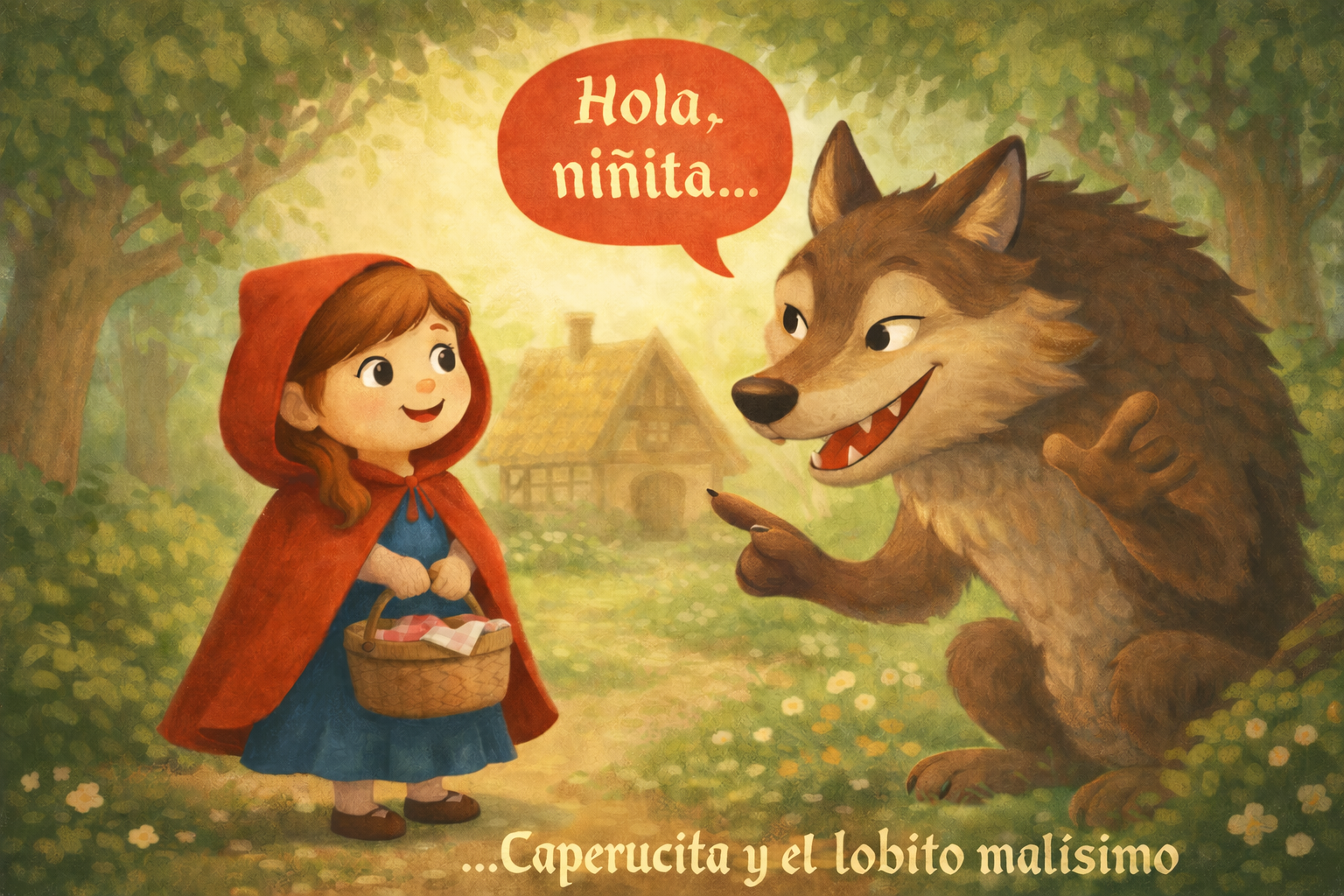
Caperucita Roja

Little Red Riding Hood

In this episode, you will listen to a traditional Spanish nursery rhyme called Los pollitos (dicen).

The episode focuses on:

  • Animals and family relationships
    • Basic needs: food, warmth, and rest
    • Repetition and rhythm in Spanish
  • Present tense verbs
    • Basic vocabulary (A1 level)
    • Understanding meaning through repetition

Before you listen, think about these questions:

  • ¿Qué animales conoces en español? Escribe cuatro.
  • ¿Qué cosas necesitas cuando tienes frío o hambre? Escribe dos.

If on a phone, scroll right

👩‍👧 Characters & Personality (A2–B1)
EspañolEnglishEspañolEnglish
👧 la niñitathe little girl👩 la madrethe mother
👵 la abuelitagranny🐺 el lobothe wolf
🧔 el cazadorthe hunter💗 hijitadear little daughter
✨ buenísimaextremely good🙏 educadísimaextremely polite
📏 obedientísimaextremely obedient😈 malísimoextremely bad
🧠 listísimoextremely clever😇 inocentísimaextremely innocent
🦸 valientísimoextremely brave💪 fuertísimoextremely strong

If on a phone, scroll right

🌲 Setting & Description (A2-B1) — Diminutives & Superlatives
EspañolEnglishEspañolEnglish
🏠 la casitathe little house🌲 el bosque grandísimothe enormous forest
🛤️ el senderito / caminitothe little path🌷 el jardínthe garden
🪟 la ventanitathe little window🚪 la puertitathe little door
🌳 los árboles altísimosthe extremely tall trees🌬️ el aire fresquitothe nice cool air
📏 larguísimoextremely long  

If on a phone, scroll right

🧺 Objects & Descriptions (A2–B1) — Diminutives & Superlatives
EspañolEnglishEspañolEnglish
🧺 la cestitathe little basket🧥 la capitathe little cape
🪑 la sillitathe little chair🌳 el arbolitothe little tree
🍯 la miel dulcísimathe extremely sweet honey🧀 el queso suavísimothe very soft cheese
🍰 el pastel deliciosísimothe absolutely delicious cake✨ brillantísimosextremely bright
🔪 afiladísimosvery sharp⚫ negrísimojet black
🎙️ suavísima (voz)very soft (voice)  

If on a phone, scroll right

💛 Emotions & Intensity (A2–B1) — Diminutives & Superlatives
EspañolEnglishEspañolEnglish
😱 asustadísima / asustadísimoextremely frightened😟 preocupadísimaextremely worried
😊 felicísimosextremely happy🙏 agradecidísimosextremely grateful
😌 tranquilitanice and calm🤒 malitaa little unwell
⭐ importantísimaextremely important⚡ rapidísimoextremely fast
📣 fuertísimos (gritos)extremely loud (screams)🌪️ terribilísimosterribly large

If on a phone, scroll right

Grammar: A) Diminutives (-ito / -ita)
EspañolEnglish
Los diminutivos se forman normalmente añadiendo -ito / -ita a un sustantivo o adjetivo.Diminutives are normally formed by adding -ito / -ita to a noun or adjective.
Se usan para indicar tamaño pequeño.They are used to indicate small size.
También pueden expresar cariño, afecto o cercanía emocional.They can also express affection, tenderness or emotional closeness.
A veces suavizan el significado de una palabra.Sometimes they soften the meaning of a word.
En ciertos contextos pueden expresar ironía o crítica.In certain contexts they can express irony or criticism.
Si la palabra termina en -a o -o, normalmente se elimina la vocal final antes de añadir el sufijo.If a word ends in -a or -o, the final vowel is usually removed before adding the suffix.
Ejemplo: casa → casitaExample: casa → little house
Si la palabra termina en consonante, normalmente se añade -ito/-ita o -cito/-cita.If a word ends in a consonant, -ito/-ita or -cito/-cita is usually added.
Ejemplo: pan → panecitoExample: pan → little roll
El diminutivo debe concordar en género y número.The diminutive must agree in gender and number.
Ejemplo: niñita / arbolitosExample: little girl / little trees

If on a phone, scroll right

Meaning Distinction — Tone Matters
EspañolEnglish
“Listo” significa inteligente o preparado.“Listo” means clever or ready.
“Listito” puede sonar cariñoso o irónico según el tono.“Listito” can sound affectionate or ironic depending on tone.
¡Qué listito eres! puede significar “you think you’re clever”, con matiz negativo.“Well, aren’t you clever!” can carry a sarcastic or negative tone.
El diminutivo no siempre indica algo pequeño; puede cambiar la actitud del hablante.A diminutive does not always indicate something small; it can change the speaker’s attitude.
👉 At B1–B2 level, this is key: diminutives carry pragmatic meaning, not just size.

If on a phone, scroll right

B) Superlatives (-ísimo / -ísima)
EspañolEnglish
El superlativo absoluto se forma añadiendo -ísimo / -ísima al adjetivo.The absolute superlative is formed by adding -ísimo / -ísima to an adjective.
Expresa un grado muy alto o extremo de una cualidad.It expresses a very high or extreme degree of a quality.
Equivale a “very”, “extremely” o “incredibly” en inglés.It is equivalent to “very”, “extremely” or “incredibly” in English.
Normalmente se elimina la vocal final antes de añadir el sufijo.The final vowel is normally removed before adding the suffix.
Ejemplo: grande → grandísimoExample: grande → enormous
Ejemplo: bueno → buenísimoExample: bueno → extremely good
El superlativo debe concordar en género y número con el sustantivo.The superlative must agree in gender and number with the noun.
Ejemplo: casas pequeñísimas / edificios altísimosExample: extremely small houses / extremely tall buildings
Algunos adjetivos presentan cambios ortográficos.Some adjectives show spelling changes.
Ejemplo: rico → riquísimoExample: rico → extremely delicious

If on a phone, scroll right

Pragmatic Use of Superlatives
EspañolEnglish
El superlativo puede expresar emoción o exageración.The superlative can express emotion or exaggeration.
Puede utilizarse de forma enfática en narraciones.It can be used emphatically in storytelling.
A veces también puede usarse con ironía.It can sometimes be used ironically.
Ejemplo: ¡Estuvo buenísimo! (entusiasmo real)Example: It was absolutely brilliant! (genuine enthusiasm)
Ejemplo: Sí, clarísimo… (tono irónico)Example: Yes, crystal clear… (ironic tone)

If on a phone, scroll right

C) Key Contrast — Form vs Meaning
EspañolEnglish
El diminutivo modifica el sustantivo y puede añadir afecto o ironía.The diminutive modifies the noun and can add affection or irony.
El superlativo intensifica una cualidad.The superlative intensifies a quality.
Ambos cambian no solo la forma de la palabra, sino también el efecto comunicativo.Both change not only the form of the word but also the communicative effect.
En textos narrativos, ayudan a crear tono y emoción.In narrative texts, they help create tone and emotion.
Members-only content

Whoopsydaisies!

This section is members-only. Luckily, there are still plenty of free goodies for you!

Already a member? Log in here

Members unlock Tabs 4-7 (Interactive transcript, bilingual transcript, quiz & downloads).

Members-only content

Whoopsydaisies!

This section is members-only. Luckily, there are still plenty of free goodies for you!

Already a member? Log in here

Members unlock Tabs 4-7 (Interactive transcript, bilingual transcript, quiz & downloads).

Members-only content

Whoopsydaisies!

This section is members-only. Luckily, there are still plenty of free goodies for you!

Already a member? Log in here

Members unlock Tabs 4-7 (Interactive transcript, bilingual transcript, quiz & downloads).

Members-only content

Whoopsydaisies!

This section is members-only. Luckily, there are still plenty of free goodies for you!

Already a member? Log in here

Members unlock Tabs 4-7 (Interactive transcript, bilingual transcript, quiz & downloads).

8. Credits
  • Narration: Jonathan Chávez
  • Story script: Jonathan Chávez
  • Music: “The Carnival of the Animals – Fossiles” by Camille Saint-Saëns, trimmed for use. Licensed under Creative Commons Attribution–ShareAlike 2.0 (CC BY-SA 2.0). Source: Wikimedia Commons.
  • Sound effects: sourced from Mixkit
  • Video production: Rafeal B – shared via Vimeo
  • Audio editing: Jonathan Chávez
  • Transcription: Jonathan Chávez
  • Study guide writer: Gabriel Chávez
  • Images: ChatGPT Plus